

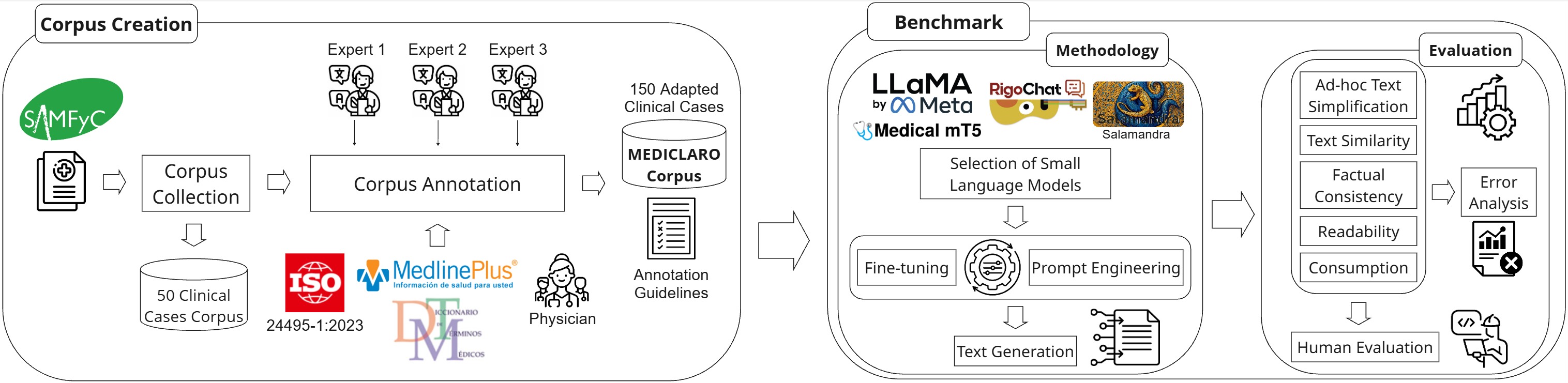
This research has been conducted by Lourdes Moreno, Jesús M. Sánchez and Paloma Martínez and it is available here. The contributions of this research are:
1. MEDICLARO corpus consisting of 50 clinical notes, each with three human-written simplifications produced by cognitive accessibility experts in accordance with ISO 24495-1. This multi-reference design reflects the inherent variability of the task and acknowledges that multiple valid adaptations may exist for the same source text.
2. Four families of state-of-the-art small language models (Llama 3.2 1B and 3B, Salamandra 2B and 7B, Rigochat-V2 7B and Medical-mT5 3B) were evaluated through fine-tuning and prompt-based strategies. The evaluation covers simplification, semantic similarity, factual consistency, readability, and environmental impact, and is complemented by human evaluation and qualitative error analysis.
3. Methodological evidence on adaptation strategies. A comparative analysis of fine-tuning and prompt-based approaches is provided, offering practical guidance for researchers and practitioners working under limited computational or data constraints.
4. Open resources for reproducible research. To support reproducibility and future research in Spanish medical NLP, the MEDICLARO corpus, the complete benchmarking framework, and the code for the adapted evaluation metrics are released as open-access resources on zenodo and Github.
The results show that Llama-3.2-3B provides the most balance profile across efficiency, robustness, and overall performance, while RigoChat-v2-7B stands out when output quality and readability are prioritized.