

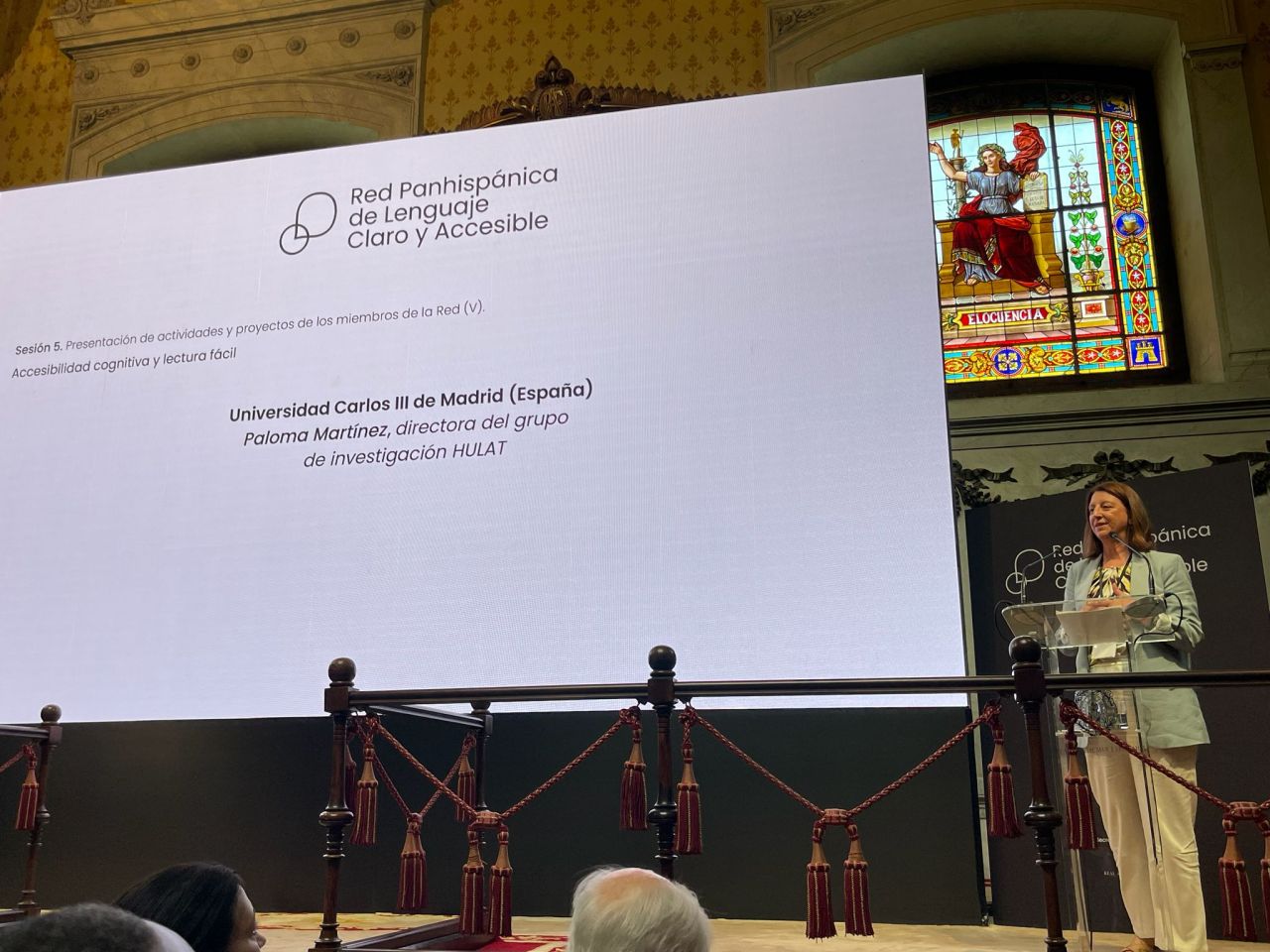
From the HULAT - Human Language and Accessibility Technologies Group, we presented some of our research projects at the event “Clear and Accessible Language and Artificial Intelligence”, held at the Royal Spanish Academy (Real Academia Española) on 26 and 27 May, as a preparatory meeting for the Third Convention of the Pan-Hispanic Network for Clear and Accessible Language.
During the session devoted to cognitive accessibility, Paloma Martínez Fernández presented several lines of work of the group and highlighted the importance of developing artificial intelligence systems supported by evidence obtained through user studies. This evidence is essential for adapting language models to different profiles and needs in tasks involving text simplification, Easy-to-Read and clear language.
Paloma Martínez also emphasised that the quality of the results cannot depend solely on automation. In this type of application, it is essential to integrate expert supervision, both to assess the linguistic and cognitive adequacy of the generated texts and to verify their alignment with standards and with the real needs of the target users.
Within the framework of the HumanAI project (https://humanai.uc3m.es/), we are exploring the generation of clear language and support for Easy-to-Read through openly available language models, with particular attention to small models that can contribute to the development of more energy-sustainable solutions. However, our approach does not propose uncontrolled automation. We believe that the evaluation of these models’ performance should not be delegated solely to automatic metrics, as these do not always capture essential aspects such as text comprehension, meaning preservation or compliance with accessibility and clear language standards.
It is not enough for a model to produce a text that appears to be simpler. It is necessary to check whether it preserves the meaning, avoids removing relevant information, does not add invented information, respects sensitive terms, integrates into a cognitively accessible interface and fits the profile of the target user. There is no universal simplification strategy that is valid for all contexts and users.
From HULAT-UC3M, through the HumanAI project, we advocate for artificial intelligence that does not operate as a black box, but rather as part of a controlled, assessable and governed process, with different levels of human participation. The combination of language models, user-based evidence, expert supervision and standards-based criteria is key to advancing towards more accessible, responsible and human-centred language technologies.
The presentation is available via the link shared by the organisation, from 1:05:
https://www.youtube.com/live/1n8HzzkNAB8?si=ZU5eTrAnRX9ckIVl